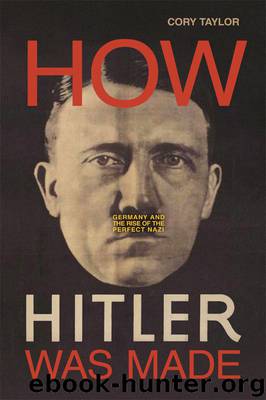
How Hitler Was Made by Cory Taylor
Author:Cory Taylor
Language: eng
Format: epub
ISBN: 9781633884366
Publisher: Prometheus Books
Violence and terror were powerful tools in postwar German politics. Militias attached to political parties on the left and the right used brute force to intimidate their political rivals. These tactics were not without historical precedent. Back in the seventeenth century, during the Thirty Year's War, when foreign armies of Roman Catholics and Protestants fought a religious struggle on German soil, bands of lawless German mercenaries roamed the countryside selling their services to the highest bidder. In the absence of a centralized military leadership, they served at the behest of their local captains: cunning and charismatic warlords who fought alongside their men.
A German captain was called der Führer (the leader), and they functioned under the Führerprinzip (leadership principle), which gave them the authority to decide all matters concerning the group. Three centuries later, the Freikorps operated on much the same basis during the counterrevolution. But in 1920, they had outlasted their usefulness, and the Treaty of Versailles demanded their dissolution. Bound by esprit de corps and unwilling to break up, many Freikorps regiments vowed to stay together. Some disguised their activities by forming business fronts such as trucking companies or rental agencies.1 Others opened youth camps or adopted harmless sounding names like the “Union for Agricultural Instruction.”2
In Bavaria, some ex-Freikorps members joined the citizen's militia. Despite pressure from Berlin to disband, for example, the Einwohnerwehr had grown to include 400,000 members with 2.5 million weapons.3 After his Freikorps regiment was disbanded and he moved to Munich, Captain Hermann Ehrhardt formed a new group called the League of Former Ehrhardt Officers. What it intended to do, nobody knew for sure.
Since the end of the war, Munich's beer halls had been arenas for vicious brawls. With demobilized soldiers, disbanded Freikorps fighters, and political extremists in the city, it's not hard to understand why. Trouble usually began with drunken patrons shouting profanities to drown out the speeches of their political rivals. Next, beer steins would start flying, followed by fistfights that often spilled out into the streets. Since its inaugural meeting in the Hofbräuhaus, the Nazi Party had been using the Saalsschutzabteilung (hall protection group) to shield Hitler from attackers at his beer hall appearances. Comprised mainly of Hitler's comrades from the war, along with bouncer types, the hall protection group would impose its will with physical violence whenever called upon. Roaming the streets of the Bavarian capital, its members also enjoyed intimidating and sometimes attacking Jews when they could find them.4 Under the protection of Ernst Pöhner, Munich's sympathetic police chief, they didn't have to worry about arrest or prosecution. Restless for action like their seventeenth century counterparts, members of the hall protection group considered these activities fun and games.
Not everyone in the Nazi leadership approved of Hitler's thugs. Party chairman Anton Drexler groused that Hitler's paramilitaries undermined the legitimacy of the NSDAP as a proper working-class movement.5 When the hall protection group was renamed the Turn und Sportabteilung (Gymnastics and Sports Section), the change didn't satisfy Drexler or conservatives in the party, who were increasingly disturbed by Hitler's leadership style.
Download
This site does not store any files on its server. We only index and link to content provided by other sites. Please contact the content providers to delete copyright contents if any and email us, we'll remove relevant links or contents immediately.
Fanny Burney by Claire Harman(26592)
Empire of the Sikhs by Patwant Singh(23069)
Out of India by Michael Foss(16845)
Leonardo da Vinci by Walter Isaacson(13310)
Small Great Things by Jodi Picoult(7113)
The Six Wives Of Henry VIII (WOMEN IN HISTORY) by Fraser Antonia(5494)
The Wind in My Hair by Masih Alinejad(5085)
A Higher Loyalty: Truth, Lies, and Leadership by James Comey(4946)
The Crown by Robert Lacey(4802)
The Lonely City by Olivia Laing(4796)
Millionaire: The Philanderer, Gambler, and Duelist Who Invented Modern Finance by Janet Gleeson(4461)
The Iron Duke by The Iron Duke(4348)
Papillon (English) by Henri Charrière(4252)
Sticky Fingers by Joe Hagan(4186)
Joan of Arc by Mary Gordon(4098)
Alive: The Story of the Andes Survivors by Piers Paul Read(4017)
Stalin by Stephen Kotkin(3956)
Aleister Crowley: The Biography by Tobias Churton(3628)
Ants Among Elephants by Sujatha Gidla(3459)
